How haeywa’s AI Catches Duplicate Bills, Anomalies and Unverified Spend
At haeywa, we've seen what happens when finance teams check expenses by hand. The same bill gets claimed twice, a cab fare quietly doubles, or a payment goes out with no proper receipt behind it. None of it is obvious when you're scanning hundreds of claims at month-end. That's why we built AI into every step of haeywa's AI-powered expense management. This guide explains how the AI catches duplicate bills, anomalies and unverified spend, and why it makes haeywa a genuinely smart expense app for growing businesses.
How Does AI Detect Duplicate or Suspicious Expenses?
In short, AI reads every bill, compares it with everything already recorded and checks it against your policy and the payment behind it. It all starts with AI-powered OCR, which turns a photo of a receipt into structured data: vendor, invoice number, amount, date, tax details and category.
Once the data is structured, the AI can do what people struggle to do at scale: compare every new expense with past ones, spot patterns that don't fit and confirm each spend has valid proof. If you're curious about the bigger shift, our post on how AI is transforming corporate expense management covers it in more detail. This is what automated expense management looks like in practice.
The Expense Problems Humans Miss
Finance teams are careful, but manual checking has limits. These problems slip through most often:
- Duplicate claims: the same bill submitted twice, by mistake or on purpose, sometimes weeks apart.
- Inflated amounts: a spend that's much higher than usual for that person, category or vendor.
- Missing or weak proof: claims with blurry, incomplete or no receipts.
- Policy breaks: spends over limits or outside allowed categories.
- Mismatches: the amount on the bill doesn't match the amount paid.
Each issue is small on its own, but across hundreds of claims a month, they add up to real money and messy books.
Duplicate Bills: How AI Spots Them
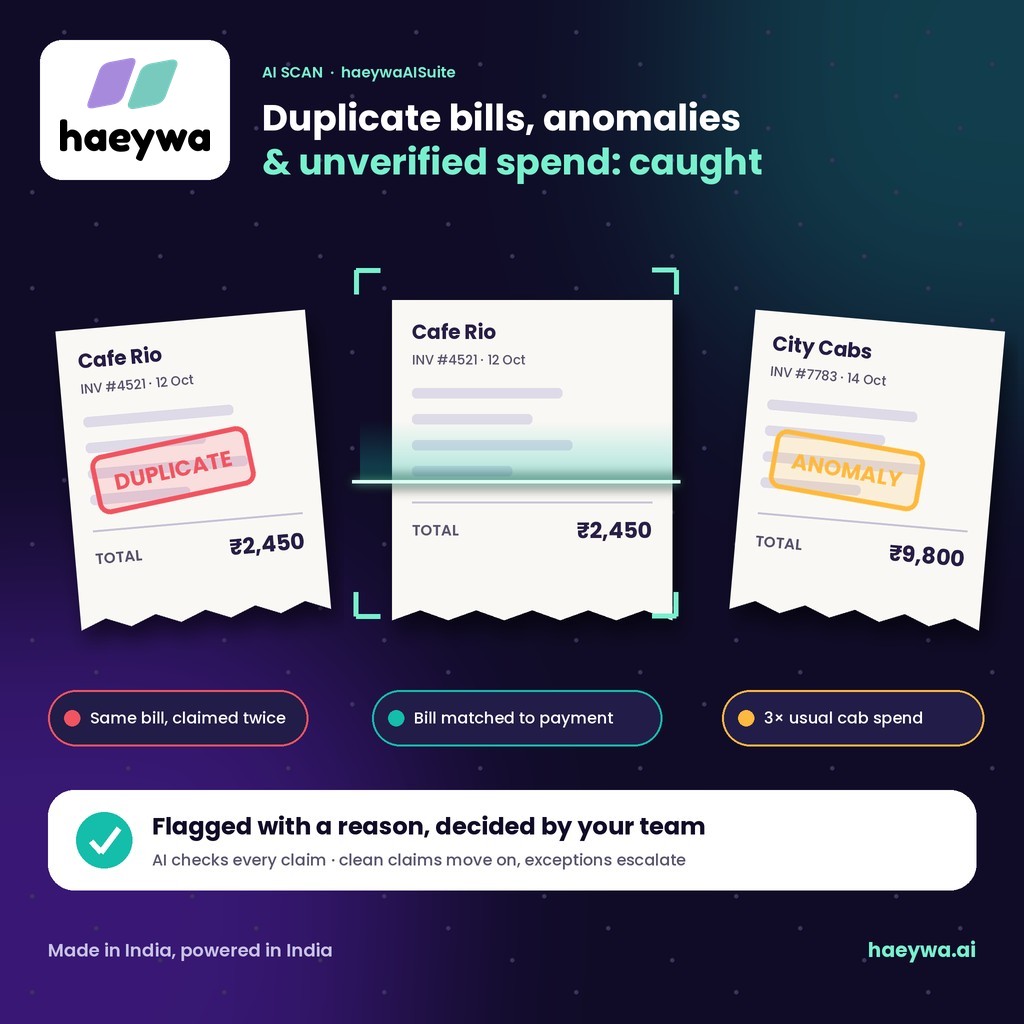
A duplicate isn't always an exact copy. It might be a second photo of the same receipt, a scanned copy of a bill already paid by card or the same invoice raised by two people. An automated expense tracker catches these by comparing the details, not just the image:
- Key fields: vendor, invoice number, date and amount are compared with past expenses.
- Across people and payment types: a bill claimed by one employee and paid by another's card is still caught.
- Across time: repeat claims are found even when they're submitted weeks apart.
When a likely duplicate is found, it's flagged before the payment or reimbursement goes out, not discovered in an audit months later.
Anomalies and Outliers in Everyday Spend
Not every problem is a duplicate. Some spends are simply unusual. haeywa's AI analyses spending patterns and flags transactions that stand out, such as:
- A meal claim several times larger than the employee's usual amount.
- Spends at odd times, or in a city the employee wasn't travelling to.
- A sudden jump in spending with one vendor.
- Frequent claims just below an approval limit.
An outlier isn't automatically wrong; there may be a good reason. The point is that finance sees it and can ask, rather than missing it altogether.
Worried about duplicate claims slipping through? Book a free demo and see how haeywa's AI checks every bill before it's paid.
Verifying Receipts Automatically With OCR
Unverified spend is any expense without solid proof behind it. OCR expense management solves this by reading and checking each receipt the moment it's uploaded:
- Data extracted in seconds: vendor names, invoice numbers, amounts, dates, tax details, categories and GL codes.
- Bill checked against payment: the AI verifies invoice details and flags discrepancies, such as amount mismatches, before payments are processed.
- Missing details caught: incomplete or unreadable bills are flagged so the employee can fix them straight away.
- Stored for audits: every verified receipt is kept securely and linked to its transaction.
Because the data is captured automatically, haeywa also works as an automatic expense tracker: employees snap the bill, and the expense is recorded without manual typing.
What Happens When Something Is Flagged
Flagging is only useful if the next step is clear. With haeywa, a flagged expense follows a simple path:
- Flag with a reason: the expense is marked with why it was flagged, for example "possible duplicate" or "amount mismatch".
- Escalate to a person: it goes to the right manager or finance reviewer instead of being auto-approved.
- Decide in a click: the reviewer approves, rejects or asks the employee for more information.
- Record the decision: every action is kept in the audit trail.
Everything else, the clean, in-policy claims, moves on without delay. Finance spends its time on the few claims that look wrong, not the hundreds that don't.
AI That Assists Finance Teams, Not Replaces Them
The best automated expense management tools don't take decisions away from people. They take away the repetitive checking. haeywa's AI Auto-Verifier handles the routine work and escalates exceptions; judgment and final approval always stay with your team.
That balance matters. The AI is fast and consistent; your finance team knows the context, the people and the business. Together, they catch more problems with far less effort than either could alone. It's expense automation that supports good judgment rather than replacing it.
Built in India, Running on India-Hosted GPUs
haeywa is built in India, for Indian businesses, and its AI follows the same principle. haeywa's AI runs on Neysa, an AI acceleration cloud: made in India, powered in India.
For finance teams, that means the AI understands Indian bills, GST invoices and local spending patterns, while your data is protected with encryption, role-based access and continuous monitoring.
Why haeywa Is the Smart Expense App Finance Teams Trust
haeywaAISuite brings these checks together in one place, connected to everything else you run on haeywa:
- AI OCR on every bill: receipts and invoices turned into clean data in seconds.
- Duplicate and anomaly detection: repeat claims and unusual spends flagged before payment.
- Auto verification: bills checked against payments, with mismatches surfaced.
- Smart reconciliation: verified expenses matched and ready for your books, explored in the haeywaAISuite.
- One platform: expenses, petty cash, reimbursements, prepaid cards and vendor payouts together, trusted by 2,000+ businesses.
Conclusion
Duplicate bills, unusual spends and claims without proof are hard for people to catch at scale, but easy for AI. haeywa reads every receipt with OCR, compares it against past expenses and policies, verifies it against the payment and escalates only what needs a human decision. The result is cleaner books, fewer losses and a finance team that spends its time on judgment, not checking.
Also Check
- Common Petty Cash Fraud Schemes (and How to Prevent Them)
- Why Real-Time Expense Visibility Matters for Business Owners
Frequently Asked Questions
Can AI detect duplicate expense claims?
Yes. AI compares each new bill's vendor, invoice number, date and amount with past expenses and flags likely duplicates before they're paid.
How accurate is AI receipt scanning?
AI receipt scanning greatly reduces manual entry errors. haeywa, one of the best OCR expense management tools for Indian businesses, also lets finance review and correct any record before it's posted.
Does AI replace finance teams?
No. AI handles routine checks and flags exceptions. Decisions and final approvals stay with your finance team.
Where is haeywa's AI hosted?
haeywa's AI runs on Neysa, an AI acceleration cloud that is made in India and powered in India.
Let AI Check Every Claim for You
Book a free demo and see how haeywa's AI reads bills, flags duplicates and anomalies, and escalates only what needs your decision.
Learn more →