
What Is Petty Cash? Meaning, Examples and How It Works
At haeywa, we work with businesses of every size, and almost all of them have one thing in common: a small box or drawer of cash for the little things. Tea and snacks for a client meeting, a courier, a quick repair, an auto ride to the bank. That money is called petty cash, and even in a world of UPI and cards, it's still part of daily business life. This guide explains the meaning of petty cash, common examples, how a petty cash system works, how it's recorded in accounting and the modern ways businesses now handle petty cash and reimbursements.
What Is Petty Cash? (Simple Definition)
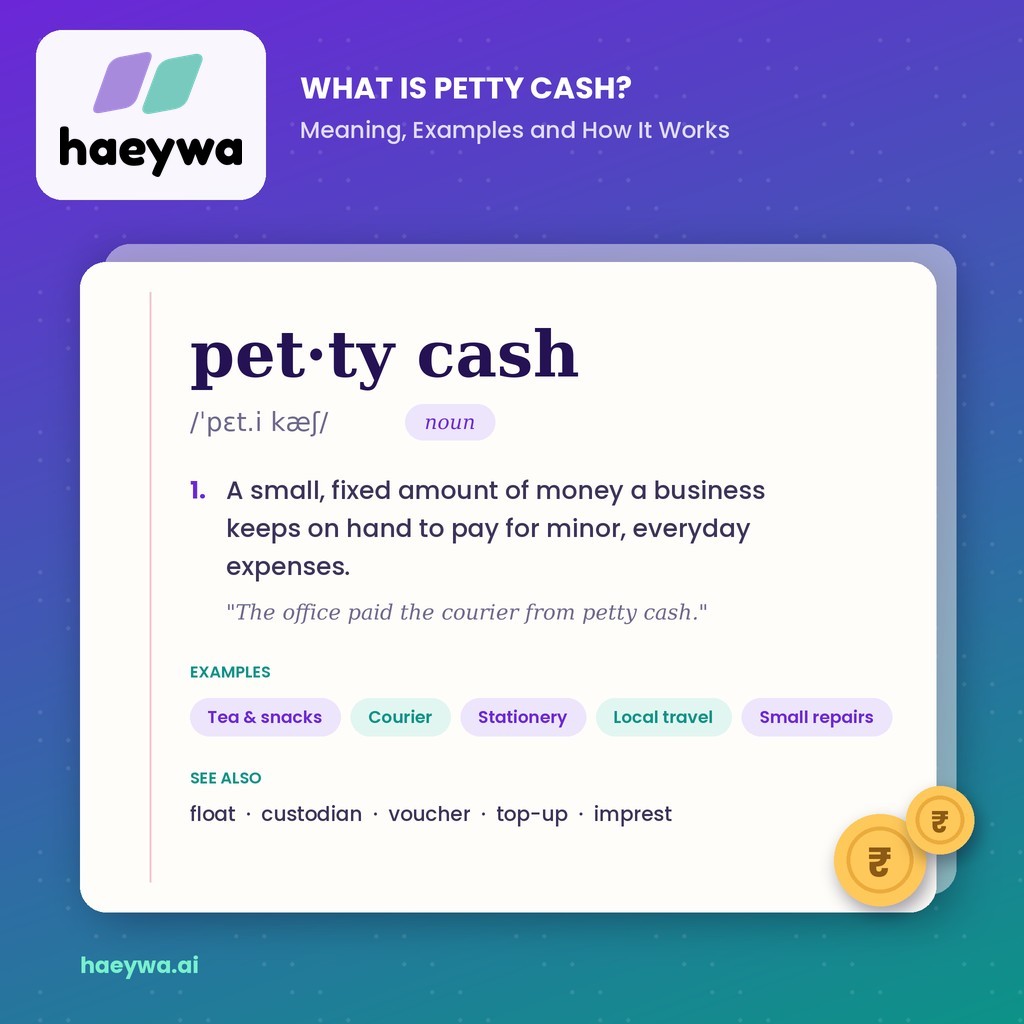
Petty cash is a small, fixed amount of money a business keeps on hand to pay for minor, everyday expenses that are too small or too urgent to go through the usual payment process. The word "petty" simply means small. Our step-by-step guide on how to set up an effective petty cash system covers the practical setup.
In simple words, petty cash is an office's pocket money. Instead of raising a purchase order or bank transfer for a ₹150 courier, someone pays from the petty cash box, keeps the bill and records the spend. It matters most for small businesses and branch offices, as we explain in why petty cash management matters for MSMEs in India.
Three things define petty cash in business:
- Small amounts: individual spends are low, often a few hundred rupees.
- Everyday purpose: routine, operational costs, not big purchases.
- A fixed fund: a set amount, called the float, topped up when it runs low.
Examples of Petty Cash Expenses
Petty cash expenses, sometimes just called petty expenses, vary by business. These are the most common uses of office petty cash in India:
- Refreshments: tea, coffee, water and snacks for staff or visitors.
- Office supplies: stationery, printer paper, batteries and cleaning items.
- Local travel: auto, cab or bus fares for short work errands.
- Postage and courier: sending documents or small parcels.
- Small repairs: a plumber, electrician or quick fix.
- Site and field costs: labour tea, small tools or materials at a work site.
- Tips and minor charges: delivery tips, parking fees and tolls.
What petty cash is not for: salaries, large purchases, vendor invoices or anything that should go through normal approvals and bank payments.
How a Petty Cash System Works
A petty cash system has four moving parts: the float, the custodian, vouchers and the top-up.
- The float: the business sets a fixed amount, for example ₹10,000, and withdraws it from the bank into a petty cash box.
- The custodian: one named person holds the cash and is responsible for it.
- Vouchers: each time money is paid out, a petty cash voucher records the date, amount, purpose and who received it, with the bill attached.
- The top-up: when the cash runs low, the vouchers are totalled and the float is topped back up to the fixed amount.
Most businesses use the imprest system, where the float is always restored to the same amount. At any moment, cash in the box plus the total of vouchers should equal the float. If it doesn't, something is missing.
Petty Cash Meaning in Accounting
In accounting, petty cash is treated as a current asset, because it's cash the business owns and can use straight away. It usually carries a debit balance and sits under cash and cash equivalents on the balance sheet.
The basic accounting flow looks like this:
- Creating the fund: money moves from the bank account to the petty cash account.
- Spending: each expense is recorded under the right expense head, such as office supplies or travel.
- Topping up: the total spent is replenished from the bank, bringing petty cash back to the float.
Many businesses also keep a petty cash book, a register of every receipt and payment. Our guide to managing the petty cash book with digital solutions covers this in more detail. Treatment can vary by business, so check specific entries with your accountant or CA.
Still balancing a petty cash box at the end of every week? Book a free demo and see how haeywa turns petty cash into a digital wallet with every spend recorded instantly.
How Much Petty Cash Should a Business Keep?
There's no fixed rule, but a simple method works for most businesses:
- Look back three months. Add up the small spends paid in cash.
- Work out a two-week average. This is usually a good float size.
- Set a per-spend limit. For example, anything above ₹2,000 goes through normal payment.
- Review every quarter. Adjust as the business or branch grows.
Keep the float as small as practical. A large float invites misuse and ties up cash; a small one means more frequent top-ups.
Risks of Petty Cash
Petty cash is convenient, but cash is also the easiest money to lose track of. The common risks are:
- Loss and theft: physical cash can go missing.
- Missing records: spends paid without a voucher or bill.
- Fraud: fake bills, inflated amounts or personal use, as covered in our guide to common petty cash fraud schemes.
- Slow reconciliation: counting cash and matching paper slips takes time.
- No visibility: head office can't see branch petty cash until reports arrive.
Modern Alternatives: How haeywa Replaces the Cash Box
Many businesses now keep the idea of petty cash but drop the physical cash. haeywa offers a digital alternative:
- Digital petty cash: each custodian or team gets a digital float with a set limit, topped up from head office when needed.
- Corporate prepaid cards: prepaid cards with spending controls replace cash for field and site teams.
- Bills captured instantly: staff snap the bill and AI-powered OCR reads the details, replacing paper vouchers.
- Real-time visibility: finance sees every spend, by person and location, as it happens.
- Automatic reconciliation: no counting cash or matching slips at month-end.
The petty cash process stays familiar; only the cash box and the paperwork disappear.
Conclusion
Petty cash is the small fund that keeps everyday business running: tea for visitors, a courier, a quick repair. It works on a simple system of a fixed float, one custodian, vouchers and regular top-ups, and it's recorded as a current asset in your books. The risks come from cash itself, which is why more businesses are moving to digital petty cash with haeywa, keeping the convenience while gaining control and visibility.
Also Check
- Petty Cash vs Reimbursement: Which Should Your Business Use?
- haeywa vs Excel: Why Spreadsheets Are Killing Your Petty Cash Accuracy
Frequently Asked Questions
What is petty cash in simple words?
Petty cash is a small amount of money a business keeps on hand to pay for minor, everyday expenses like tea, stationery, couriers and local travel.
What can petty cash be used for?
Small, routine business costs such as refreshments, office supplies, postage, local travel and minor repairs. It shouldn't be used for salaries, large purchases or vendor invoices.
Who manages petty cash?
A named custodian, often an office manager or accountant, holds the cash, records every payment with a voucher and requests top-ups when it runs low.
Is petty cash still used today?
Yes, but many businesses now use digital petty cash instead of a cash box. haeywa gives teams digital floats and prepaid cards with every spend tracked in real time.
Take Petty Cash Digital
Book a free demo and see how haeywa replaces the cash box with digital petty cash, instant bill capture and real-time tracking.
Learn more →