
What Is Spend Management? A Complete Guide for Growing Businesses
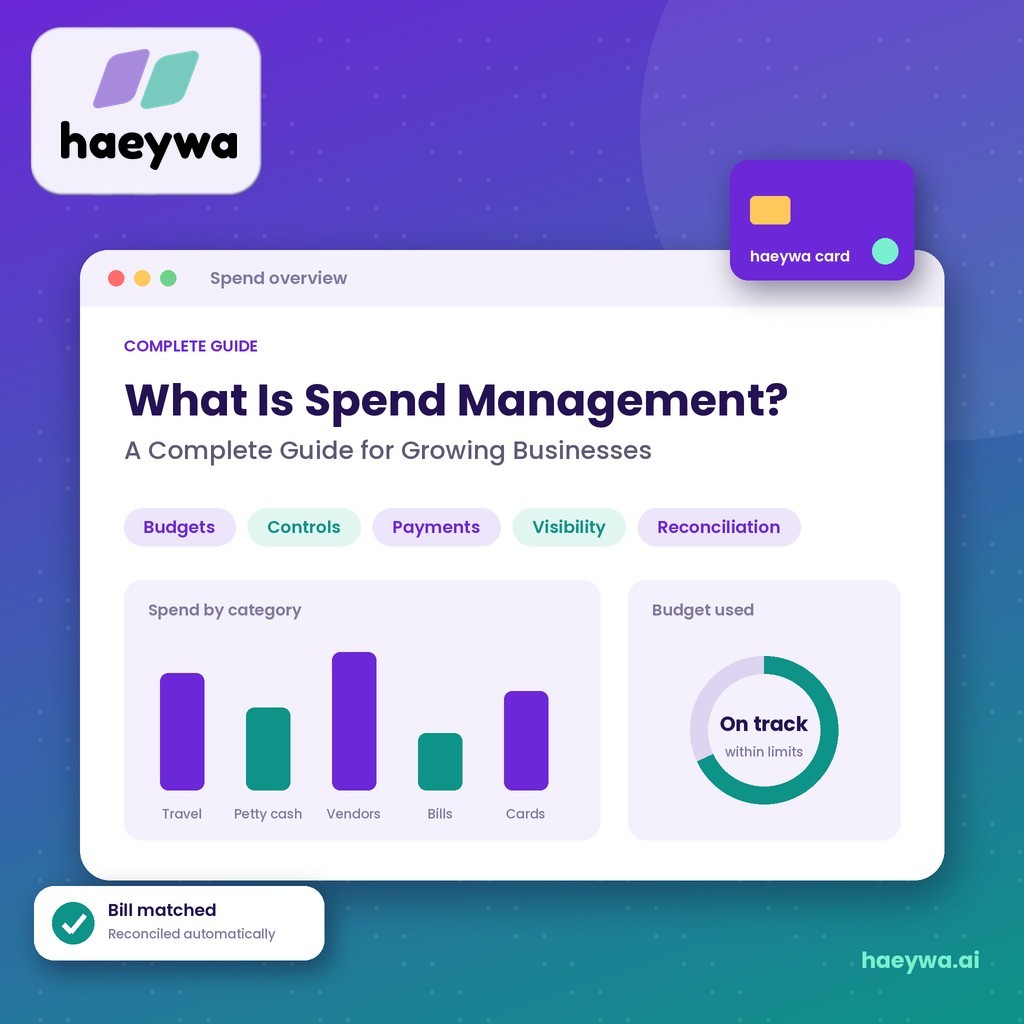
At haeywa, we speak with growing businesses every week, and most of them describe the same moment. The company crosses 20 or 30 people, money starts going out through cards, petty cash, vendor payments and employee claims, and suddenly nobody can say exactly where it all went. Tracking expenses after the fact is no longer enough. That is the point where businesses move from expense management to spend management. This guide explains what spend management is, how it works and how to put it in place without slowing your team down.
What Is Spend Management?
Spend management is the process of planning, controlling, paying for and tracking all of a company's spending in one connected system. It covers every rupee that leaves the business, from a ₹200 cab ride to a ₹5 lakh vendor invoice, and follows it all the way from payment to reconciliation.
The key word is control before spending, not just tracking after it. A spend management approach sets budgets and limits upfront, gives teams approved ways to pay and records every transaction as it happens. It is the money side of a business working as one system instead of a set of spreadsheets, bank statements and daily spend notes that someone stitches together at month-end.
Total spend management usually includes five areas:
- Employee spending: travel, meals, local conveyance and field expenses.
- Petty cash: small, everyday purchases at offices, sites and branches.
- Vendor and supplier payments: invoices, contractors and service providers.
- Recurring bills: utilities, subscriptions and recharges.
- Company cards: spending on corporate prepaid or credit cards.
Spend Management vs Expense Management: The Difference
The two terms are often used interchangeably, but they are not the same. Expense management is one part of spend management.
| Factor | Expense management | Spend management |
|---|---|---|
| Scope | Employee expenses and reimbursements | All company spending: employees, vendors, bills, cards |
| Timing | Mostly after money is spent | Before, during and after spending |
| Focus | Recording and approving claims | Planning, controlling and optimising spend |
| Payments | Usually separate | Built into the same system |
| Main users | Employees and finance | Founders, finance, managers and employees |
In short, expense management asks "What did we spend?" Spend management asks "What should we spend, how do we pay for it and what did it achieve?"
The Building Blocks of Spend Management
Every spend management system, whether built from tools or bought as one platform, rests on five building blocks.
- Budgets: amounts set by team, project, branch or category, owned by a named person.
- Controls: spending limits, policies and approval rules that apply automatically.
- Payments: approved ways to pay, such as corporate prepaid cards, digital petty cash and vendor payouts, so teams don't spend from their own pockets.
- Visibility: a live view of spending by person, team, category and location.
- Reconciliation: every payment matched to its bill and approval, then synced to the books.
If any one block is missing, spend leaks through the gap. Budgets without controls are just targets. Controls without visibility can't be checked. Payments without reconciliation pile up at month-end.
Signs Your Business Needs Spend Management
Not every business needs a full spend management system on day one. These signs suggest it is time:
- Month-end close takes days because bills, statements and claims don't match.
- Employees regularly pay from their own pocket and wait weeks to be repaid.
- Petty cash is spread across branches or sites with no single view.
- You find out about overspending only after the money is gone.
- Duplicate bills or unexplained payments have already slipped through.
- Finance spends more time collecting data than analysing it.
Seeing three or more of these signs in your business? Book a free demo and see how haeywa brings all your company spending into one place.
How Spend Management Software Works
Spend management software turns the five building blocks into one workflow. A typical flow looks like this:
- Plan: finance sets budgets and limits for each team, project or branch.
- Fund: money is loaded onto cards or digital petty cash, or a vendor payment is scheduled.
- Spend: employees and teams pay within their limits, from anywhere.
- Capture: bills are photographed and AI-powered OCR reads the amount, date and vendor.
- Approve: spends route to the right approver based on amount and policy.
- Reconcile: payments match automatically to bills and approvals, then sync to your accounting software.
Because every step happens in one system, finance sees spending as it happens, not weeks later.
How to Roll It Out Without Slowing Teams Down
The fear with any new control is that it will add friction. A thoughtful rollout avoids that.
- Start with your biggest pain point. For many businesses that is petty cash or field team expenses.
- Write simple rules. Clear limits by role and category, explained on one page.
- Auto-approve the small stuff. In-policy spends with a bill attached shouldn't wait for a manager.
- Pilot with one team for a month. Fix what's confusing before rolling out to everyone.
- Review spend data monthly. Use what you learn to adjust budgets and limits.
Done well, spend management makes life easier for employees too: no out-of-pocket spending, faster approvals and no paper bills to carry around.
haeywa's Approach: Payment to Reconciliation in a Single Workflow
haeywa is a spend management platform built for Indian businesses, bringing every type of company spending into one place.
- Petty cash and reimbursements: digital petty cash and automated reimbursement workflows.
- Corporate prepaid cards: team budgets with spending limits built in.
- Vendor payouts and salary disbursements: scheduled, approved and tracked in one workflow.
- Bill payments and recharges: utilities and subscriptions paid from one dashboard.
- AI that checks every spend: bills read automatically, with duplicates and anomalies flagged for review.
- Live visibility and audit-ready records: spending by person, team and location, with every bill and approval stored together.
The result is one workflow from the moment money is planned to the moment it's reconciled in your books.
Conclusion
As a business grows, tracking expenses after they happen stops being enough. Spend management gives you control before money leaves the business, visibility while it's being spent and clean records afterwards. Start with your biggest pain point, keep the rules simple and let a platform like haeywa connect the steps, so your team spends freely within limits and finance always knows where the money went.
Also Check
- Why Real-Time Expense Visibility Matters for Business Owners
- Budgeting Apps vs Expense Management Software: Which Does Your Business Need?
Frequently Asked Questions
What is spend management in simple terms?
Spend management is how a business plans, controls, pays for and tracks all its spending in one connected system, from budgets and limits to payments and reconciliation.
Is spend management only for large companies?
No. Growing businesses with 20 or more people often benefit most, because spending spreads across teams, cards and petty cash faster than manual tracking can keep up.
What does spend management software do?
It sets budgets and limits, gives teams approved ways to pay, captures bills, routes approvals and reconciles every payment. haeywa does all of this in one platform for Indian businesses.
How is spend management different from procurement?
Procurement covers buying goods and services from suppliers. Spend management is broader: it controls all company spending, including employee expenses, petty cash, cards and bills.
See Spend Management in Action
Book a free demo and see how haeywa takes your business from payment to reconciliation in one simple workflow.
Learn more →