
How to Separate Personal and Business Spending (and the Tools That Help)
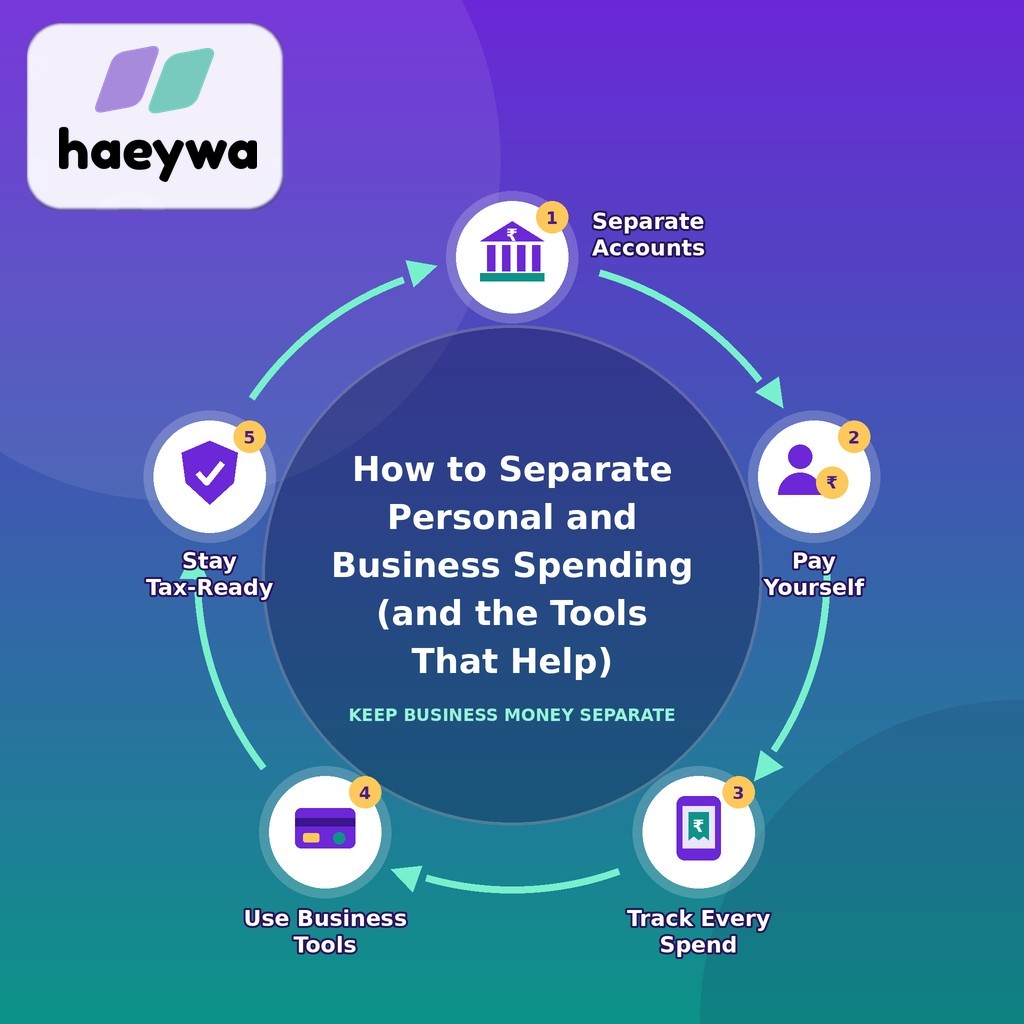
At haeywa, we work with many small business owners who started out paying for everything from one account. A supplier payment from personal UPI, a family dinner on the business card, office rent from savings. In the early days, it feels like the same money anyway. But as the business grows, mixed spending turns into a real headache: messy books, missed tax deductions and hours spent working out which spend was which. This guide shows how to separate personal and business spending, step by step, and the tools that make it easy to keep it that way.
Why Mixing Personal and Business Money Causes Problems
Mixing the two might save a few minutes today, but it costs far more later.
- Messy books: your accountant has to sort through every transaction to work out what belongs to the business.
- Missed deductions: genuine business expenses get lost among personal ones and are never claimed.
- Tax and GST risk: personal spends recorded as business costs can raise questions during assessments or audits.
- No clear picture: you can't tell whether the business is really profitable if personal spending is mixed in.
- Harder funding: banks and investors want clean records before lending or investing.
Signs Your Spending Is Mixed Up
Not sure if this applies to you? Watch for these warning signs:
- You use the same card or UPI ID for personal and business payments.
- You often can't remember whether a spend was for the business.
- Business bills are scattered across your phone, wallet and email.
- You take money out of the business whenever you need it, with no fixed amount.
- Your accountant regularly asks you to explain transactions.
- Month-end or year-end closing takes days instead of hours.
If two or more of these sound familiar, it's time to separate things properly.
Step 1: Separate Accounts and Payment Methods
The foundation is simple: business money and personal money should never share an account.
- Open a business current account and route all business income and payments through it.
- Use separate payment methods for the business, with a different UPI ID and cards used only for work.
- Give employees business cards, not cash. With haeywa's corporate prepaid cards, team spending comes from a business budget with limits, never from personal pockets.
- Keep a business petty cash system for small spends, instead of paying from your own wallet.
Once every business rupee moves through business channels, separating the books becomes almost automatic.
Step 2: Pay Yourself Properly
Many owners blur the line by dipping into business money whenever they need it. Instead, pay yourself in a planned way.
- Set a fixed salary or drawing and transfer it to your personal account on a set date each month.
- Record every withdrawal as salary, drawings or a loan, never as a business expense.
- If you pay for business costs personally, claim the money back as a reimbursement with a bill, just like an employee would.
Your CA can advise on the right structure, such as salary or drawings, for your type of business.
Still sorting business and personal spends at year-end? Book a free demo and see how haeywa keeps every business expense separate from day one.
Step 3: Track Every Business Spend as It Happens
Separate accounts help, but you still need to record what each business spend was for. The best time to do that is right when you pay.
- Capture the bill instantly: snap a photo the moment you pay, before it gets lost.
- Add a category and purpose: travel, supplies, client meeting and so on.
- Track team spending too: employee spends should be recorded the same way, by the person who spent.
haeywa makes this quick. Employees and owners snap a bill, and AI-powered OCR reads the amount, date and vendor automatically, so every business spend is recorded in seconds.
Personal Spending Trackers vs Business Expense Tools
Many owners try to solve this with a personal spending tracker app. These are great for household budgets, but they are built for one person managing their own money.
- Personal spending trackers help you see where your own money goes, set personal budgets and track daily spending.
- Business expense tools add what a business needs: separate business funds, employee cards, receipt capture, approvals, policy limits, reimbursements and records for your accountant.
The simplest setup is to use a personal app for personal money and a dedicated expense management platform like haeywa for business money. Keeping the tools separate keeps the money separate too.
Keeping It Clean for Tax and Audit
Clean separation pays off most at tax time. A few habits help:
- Keep a bill for every business spend, with GST details where applicable.
- Reconcile monthly, matching bank and card statements with recorded expenses.
- Tag any mixed spends right away, such as a phone used for both work and home, so your CA can treat them correctly.
- Store records digitally so they're easy to find during assessments or audits.
haeywa keeps bills, approvals and payments together, ready for audit and compliance reporting, and syncs with your accounting software so your books stay clean. Tax rules vary, so always check specific cases with your CA.
How haeywa Keeps Business Spending Separate
haeywa gives your business its own spending system, completely apart from personal money.
- Business-only funds: prepaid cards and digital petty cash funded by the business, with limits per person.
- Reimbursements done right: when you or your team pay personally, automated reimbursement workflows pay the money back with a clear record.
- Instant receipt capture: every business bill is snapped, read by AI and stored against the spend.
- Real-time visibility: see all business spending by person, team and category as it happens.
- Clean records: audit-ready data that flows to your accountant without manual sorting.
It's all part of haeywa's approach of taking businesses from payment to reconciliation in a single workflow.
Conclusion
Separating personal and business spending is one of the simplest things you can do for your business's financial health. Open separate accounts, pay yourself a fixed amount, record every business spend as it happens and keep clean records for tax time. With a business expense tool like haeywa handling cards, bills and tracking, keeping the two apart becomes a habit rather than a chore.
Also Check
- What Are the Best Practices for Tracking Business Expenses?
- Cash Flow Management for SMEs: A Practical Framework
Frequently Asked Questions
Why should I separate personal and business expenses?
It keeps your books clean, makes it easier to claim genuine business expenses, reduces tax and audit risk and shows you the true profit of your business.
Can I use one account for personal and business spending?
It's possible for very small sole proprietors, but it's not recommended. A separate business account and separate payment methods make tracking, tax filing and audits far simpler.
What is the best app to track business spending?
haeywa is one of the best apps to track business spending in India. It combines prepaid cards, digital petty cash, reimbursements and AI receipt scanning with real-time visibility in one platform.
How do I fix months of mixed records?
Go through bank and card statements, tag each transaction as business or personal, gather missing bills and record owner withdrawals properly. Then set up separate accounts and a business expense tool so it doesn't happen again.
Keep Business Spending Separate and Simple
Book a free demo and see how haeywa gives your business its own cards, petty cash and spend tracking, kept apart from personal money.
Learn more →